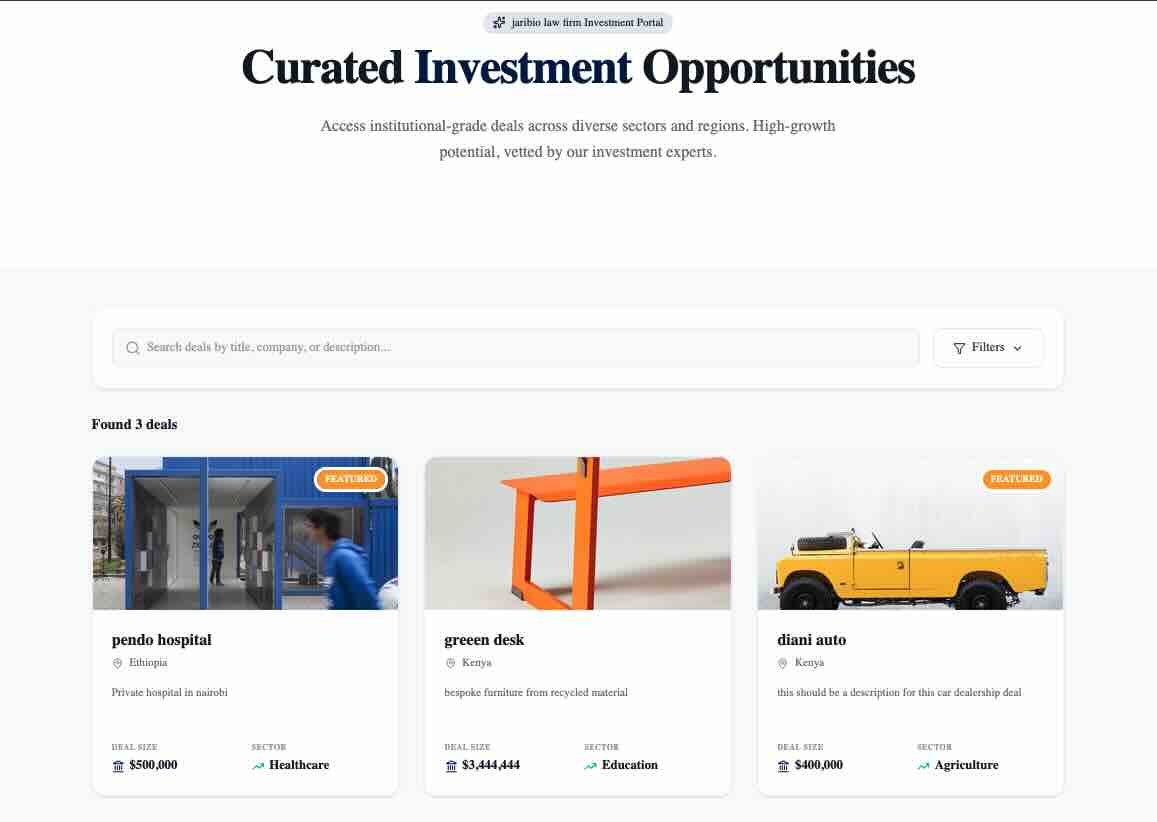
In the world of fintech and capital raising, the barrier to entry isn’t just a good idea—it’s infrastructure. When dealing with high-stakes financial data, regulatory compliance, and multiple stakeholders, “good enough” software is a liability.
I built CapitalOS to solve this problem: a cloud-based, multi-tenant platform designed to streamline the capital raising process for founders and investors alike.
The Backend: Why NestJS (Node.js) is the Enterprise Choice
For a platform like CapitalOS, the backend needs to be more than just fast; it needs to be maintainable, testable, and strictly typed. That’s why I chose NestJS.
-
Modular Architecture: NestJS allows us to treat different platform features (Identity Verification, Document Management, Fund Tracking) as isolated modules. This is critical for preventing “spaghetti code” as the platform scales.
-
TypeScript-First: In financial software, a single type error can be catastrophic. Developing in TypeScript ensures that our data structures remain consistent from the database to the API response.
-
Built-in Security: Using NestJS’s guards and interceptors, we implemented a robust Role-Based Access Control (RBAC) system, ensuring that sensitive investment data is only accessible to authorized users.
The Frontend: A High-Fidelity React Interface
Investment platforms require a high degree of trust, which is often communicated through the User Interface (UI). We used React to build a responsive, single-page application that feels more like a desktop tool than a website.
-
State Management: Handling complex investor dashboards and real-time capital tracking requires sophisticated state management. React allows for a fluid user experience where data updates instantly without page reloads.
-
Component Reusability: By building a custom library of financial components (charts, data tables, progress trackers), we can iterate on new features for CapitalOS at a fraction of the traditional development time.
The Multi-Tenant Challenge: Data Isolation in the Cloud
One of the most complex aspects of CapitalOS is its multi-tenant architecture. The platform must support multiple independent organizations simultaneously, each with its own siloed data, users, and branding.
We achieved this by implementing a “Shared Schema, Isolated Data” approach (or a schema-per-tenant model, depending on the client’s regulatory needs). This ensures that while the core engine of CapitalOS is shared to keep maintenance costs low, the data integrity of each tenant is never compromised.
Deployment & Scalability
CapitalOS is a cloud-native platform. By leveraging a modern DevOps pipeline—similar to the ones I architect for my consultancy clients—we ensure:
-
High Availability: Automated failovers and load balancing.
-
Continuous Deployment: New features and security patches are rolled out with zero downtime.
-
Elastic Scaling: The platform automatically adjusts its resources based on the current load, whether it’s a quiet Sunday or the middle of a major funding round.
Project A description